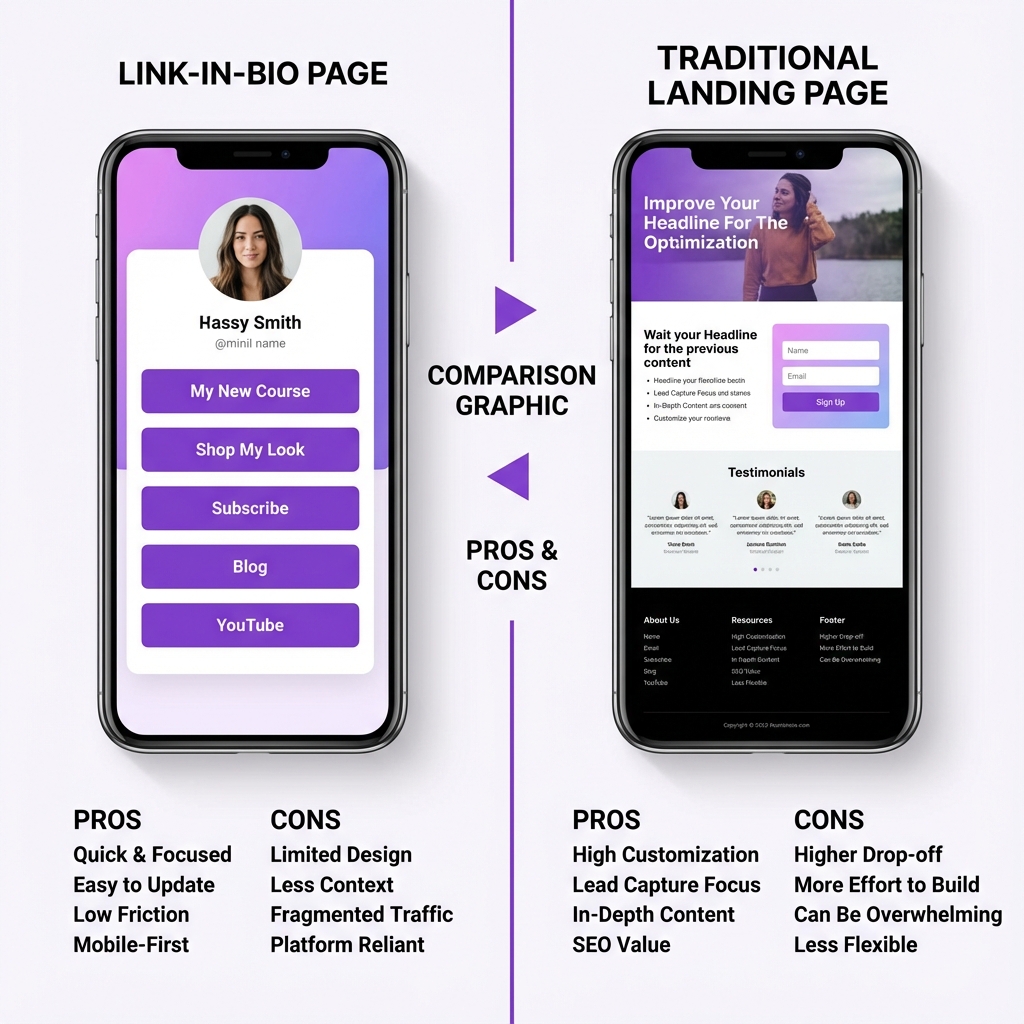
Link-in-Bio vs Landing Page: When to Use Each (And Why AI Changes Everything)
If you're a digital marketer, creator, or small business owner, you've likely faced the "Platform Dilemma." You have a great campaign running on Instagram or TikTok. You know you need to drive that traffic somewhere. Should you send them to a simple link-in-bio page (like Linktree or Tagnovate), or a dedicated, long-form landing page? For years, the answer was a simple trade-off between simplicity (link-in-bio) and conversion control (landing page). But as we enter 2025, the lines are blurring. Modern bio links are becoming "Micro-Landing Pages" equipped with AI, while traditional landing pages are feeling increasingly slow and heavy for a mobile-first audience. In this guide, we’ll break down the technical and strategic differences between a link-in-bio vs landing page and explain why the "Conversational Bio" is the best of both worlds.
Table of Contents
- Definitions: Link-in-Bio vs. Landing Page
- The SEO Comparison: Who Wins on Google?
- Conversion Metrics: The Cold, Hard Data
- User Experience: Why Mobile-First Matters
- The 'Third Way': AI-Powered Smart Bios
- Decision Matrix: When to Use Which?
- The Future of the 'Bio Page' Landscape
- FAQ Section
Definitions: Link-in-Bio vs. Landing Page
Let's clear the air on what exactly these two formats are:
- Link-in-Bio Page: A mobile-optimized hub that acts as a central directory for all your online presence. It typically features buttons, social icons, and increasingly, embedded content and AI assistants. It lives in your social media profile.
- Landing Page: A standalone web page, created specifically for a marketing or advertising campaign. It is where a visitor "lands" after they click on a link in an email, or ads from Google, Bing, YouTube, Facebook, or Instagram. It usually has one single objective (CTA). [INTERNAL_LINK: is-linktree-bad-for-seo]
The SEO Comparison: Who Wins on Google?
Historically, the landing page was the undisputed SEO champion. Because a landing page is part of your main website, every visit and backlink builds your Domain Authority (DA). Traditional link-in-bio tools (like basic Linktree) actually cannibalize your SEO. You’re sending all your high-value social traffic to Linktree’s domain, not yours. However, the game has changed. Modern bio link tools (like Tagnovate) now support Custom Domains. This means your bio link can be hub.yourbrand.com. Now, your bio link is an SEO-optimized landing page. It has all the mobile speed of a bio link but all the SEO juice of a landing page. According to Search Engine Journal, page speed is a top 3 ranking factor for mobile search in 2025. This gives the fast-loading bio link a massive advantage over heavy, image-laden landing pages.
Conversion Metrics: The Cold, Hard Data
Which one actually makes you more money?
- Landing Pages excel at "High Friction" conversions. If you're selling a $5,000 corporate consulting package, you need the space of a landing page to explain the benefits, show the data, and build the case.
- Link-in-Bio Pages excel at "Momentum" conversions. If you're selling a $29 ebook or a newsletter subscription, the 1-second load time of a bio page leads to significantly higher completion rates. A study by Unbounce found that every 100ms of delay in page load time can drop conversion rates by 7%. Landing pages (especially those built on WordPress or heavy builders) often take 2-4 seconds to load in the Instagram browser. A bio page loads in under 500ms. AI Chatbot for Link-in-Bio
User Experience: Why Mobile-First Matters
Over 80% of social media traffic is mobile. A traditional landing page is often "Responsive" (it looks okay on mobile), but it wasn't born there. A bio link is "Mobile-First." It feels native to the app the user just came from. Large, thumb-friendly buttons and a vertical layout are the native language of the mobile user.
The 'Third Way': AI-Powered Smart Bios
This is where 2025 gets exciting. The "Smart Bio" (pioneered by Tagnovate) combines the simplicity of a bio link with the sales power of a landing page using an AI Chatbot. Instead of a long, static page of text (landing page), you have a conversational assistant.
- The Problem with Landing Pages: Information is hidden.
- The Problem with Bio Links: Information is minimal.
- The AI Solution: High-density information, delivered on demand via chat. A visitor who wants to know your refund policy can just ask the bot instead of hunting through 2,000 words on a landing page. [INTERNAL_LINK: rag-chatbot-for-business]
Decision Matrix: When to Use Which?
Use this matrix to choose your strategy:
| If you are... | Use a Link-in-Bio | Use a Traditional Landing Page |
|---|---|---|
| A Solopreneur / Coach | ✅ (Use a Smart Bio) | ❌ |
| Running Ads ($1k+/day) | ❌ | ✅ |
| Selling Low-Ticket Digital Products | ✅ | ❌ |
| An Agency Building Authority | ✅ (Custom Domain) | ✅ |
| Focusing on Personal Brand | ✅ | ❌ |
The Future of the 'Bio Page' Landscape
The term "Link-in-Bio" is growing up. It’s no longer just for links; it’s for entire business ecosystems. In 2025, the most successful brands will treat their bio link as their primary mobile landing page, reserving their main website for deep SEO content and long-form resources. With the advent of AI, your bio page becomes a dynamic salesperson that can do more in 100 vertical pixels than a 5,000-word landing page can do in 10 scrolls.
Conclusion
The debate of link in bio vs landing page is no longer a choice between "Simple" and "Professional." With tools like Tagnovate, your bio link is a professional, AI-powered, SEO-optimized landing page. For 90% of creators and small businesses, a Smart Bio is the faster, cheaper, and higher-converting option.
FAQ Section
Is a bio link strictly for social media?
No. Many businesses use their "Smart Bio" link as the footer link in their emails or as the primary link on their business cards (especially NFC business cards).
Does Linktree hurt my SEO?
If you use their free version on their domain, yes, you are building their authority, not yours. If you use a tool that supports custom domains, you regain that SEO power.
Can I track conversions on a bio link?
Yes. Modern platforms support Google Analytics, Meta Pixel, and TikTok Pixel integration, so you can track your "Return on Ad Spend" (ROAS) perfectly.
Which is cheaper to maintain?
A bio link is significantly cheaper. Most premium bio tools are $10-$40/mo, whereas landing page builders (like ClickFunnels or Leadpages) can cost $100-$300/mo.
Can I have both?
Actually, YES. Many top creators send their "General" traffic to a Smart Bio link, but send their "Paid Ad" traffic to a specific, high-friction landing page. {/* IMAGE SUGGESTIONS */}
- Hero: A "Decision Tree" graphic showing when to use a bio link vs. a landing page.
- Infographic: "The Load Time Gap" – comparing how many customers you lose for every second a page takes to load.
- Chart: Conversion rate comparison for low-ticket vs. high-ticket products between the two formats.
- Infographic: "The Evolution of the Bio Link" – from 2016 (Linktree) to 2025 (AI Smart Bio). {/* SCHEMA SUGGESTION: Article, FAQ, HowTo /} {/ INTERNAL LINKS TO ADD */}
- [INTERNAL_LINK: best-link-in-bio-for-selling-digital-products]
- [INTERNAL_LINK: how-to-automate-freelance-business]
Tags
Ready to transform your link-in-bio?
Join thousands of creators using Tagnovate's AI-powered platform to engage visitors and boost conversions.
Start Free Trial